
Indoor cats live safer lives—but safety alone doesn’t guarantee fulfillment.
Without daily mental challenges, even the most affectionate indoor cat can quietly drift into boredom, restlessness, or emotional tension. These shifts often happen gradually, making them easy to overlook until behaviors start changing.
Mental stimulation is not about tiring your cat out. It’s about engaging their instincts in ways that feel meaningful, predictable, and emotionally satisfying.
Why Mental Stimulation Is Essential for Indoor Cats
Cats evolved as intelligent, adaptive hunters. Their brains are wired to observe, plan, stalk, and solve problems throughout the day.
Outdoor environments naturally provide this stimulation. Indoor environments do not—unless we intentionally design them to.
Early signs of insufficient mental engagement often include:
-
Sleeping more but resting less
-
Increased vocalization or attention-seeking
-
Sudden bursts of energy at odd hours
-
Fixation on shadows, reflections, or movement
-
Mild irritability during handling or play
These behaviors are not personality flaws. They’re feedback.
A deeper understanding of how subtle environmental cues, emotional safety, and daily structure quietly shape feline behavior can be found in thoughtful explorations of the invisible foundations that support a cat’s overall well-being.
Once you begin viewing behavior as communication, play becomes a form of care rather than entertainment.
Mental Play vs. Physical Play: Why the Brain Matters More Than Speed
Many cats get physical exercise without true mental engagement.
Chasing a laser pointer may burn energy, but it doesn’t allow completion of the hunting sequence. Without a “catch,” frustration can quietly build.
Mentally enriching games usually include at least one of the following:
-
Decision-making
-
Problem-solving
-
Anticipation
-
Sensory feedback
When these elements are present, cats don’t just move—they process.
That processing is what leads to calm, content behavior afterward.
Interactive Games That Activate Natural Instincts
The most effective indoor games mimic real-life hunting patterns in short, satisfying cycles.
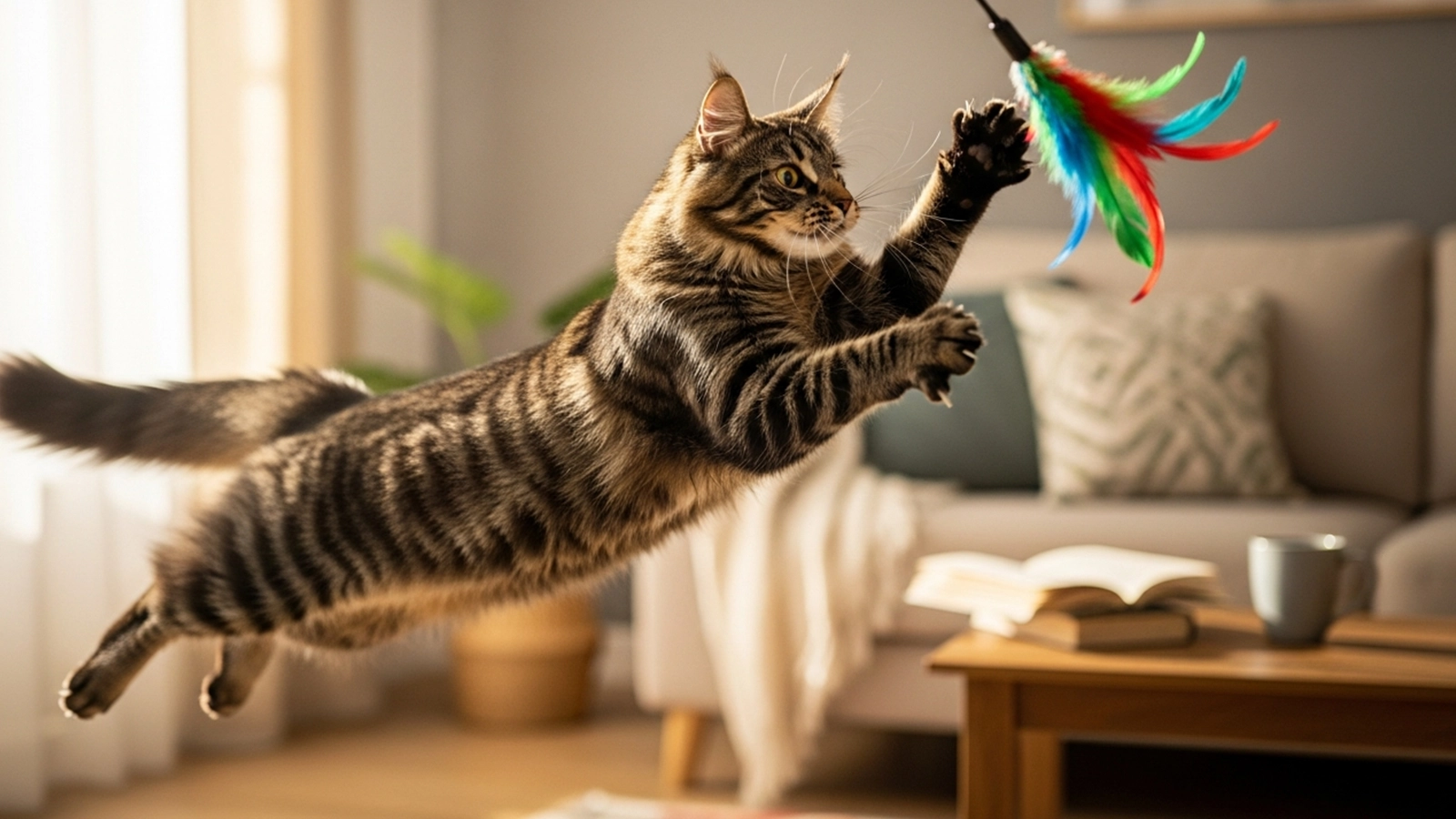
Structured Wand Toy Play
Instead of constant motion, slow things down.
A healthy play cycle looks like this:
-
Slow movement along the floor (stalking)
-
Brief pauses behind furniture
-
Sudden bursts of motion
-
A successful capture
Always allow your cat to “win” at the end.
Follow the session with a small treat or meal to complete the instinctual loop. This reduces frustration and supports emotional regulation.
Hide-and-Reveal Games
Drag a ribbon or soft toy behind a couch or door frame and let your cat anticipate where it will reappear.
This type of play builds:
-
Focus
-
Prediction skills
-
Patience
Changing hiding spots keeps the game mentally fresh without increasing intensity.
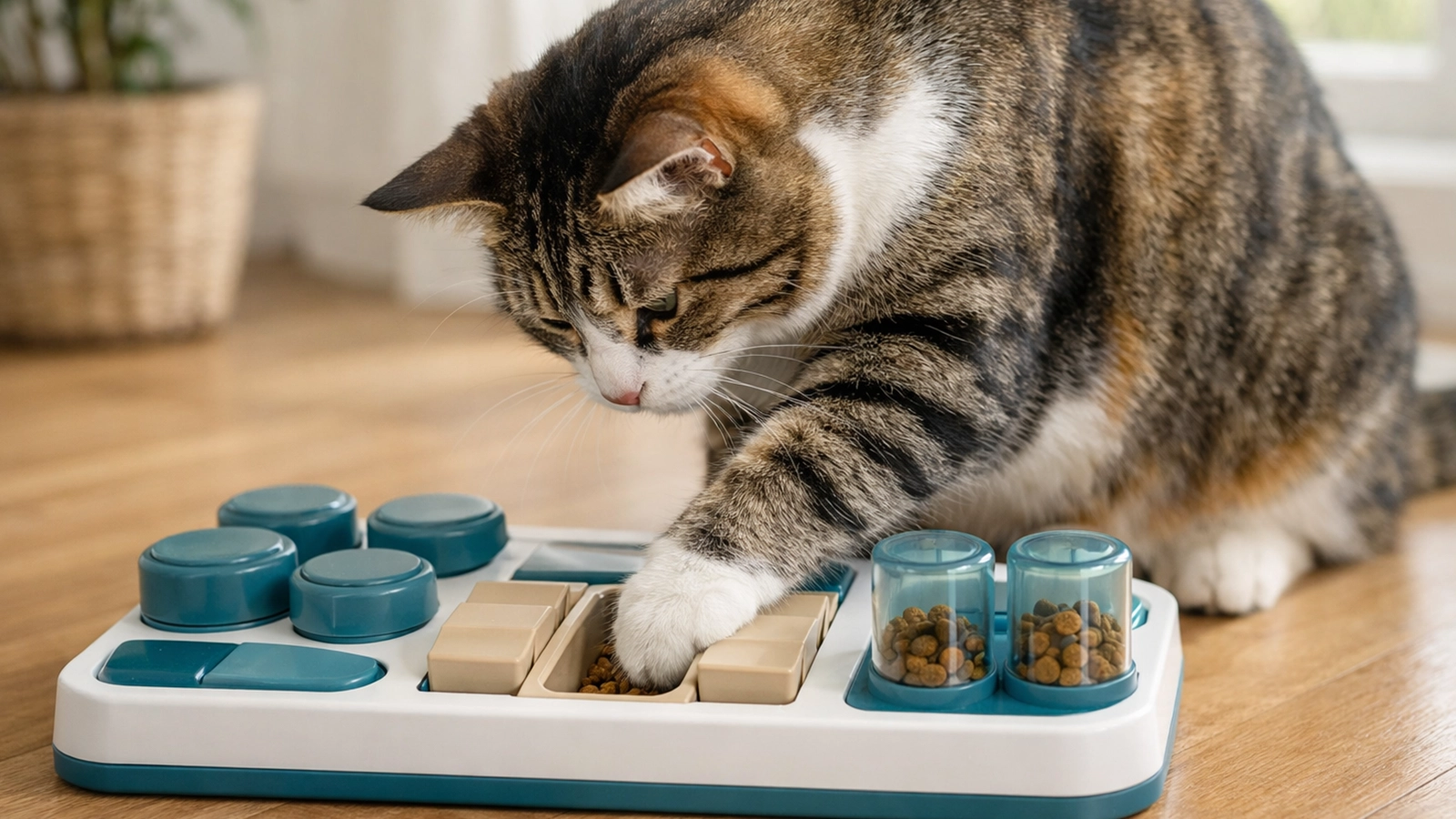
Puzzle Feeding: Turning Meals Into Brain Work
Food puzzles are one of the most powerful mental enrichment tools for indoor cats.
They transform eating from a passive activity into an engaging task.
Benefits include:
-
Slower eating ✔️
-
Reduced food obsession ✔️
-
Increased confidence ✔️
Simple DIY options work well:
-
Treats hidden in a cardboard egg carton
-
Kibble inside a folded paper towel roll
-
Muffin tins with toys covering food
Start easy. If your cat walks away, the puzzle is too hard—not motivating.
Independent Thinking Games for Quiet Hours
Not all enrichment needs human involvement.
Independent games are especially important during work hours or quiet evenings.
Exploration Boxes
Create a simple discovery box using:
-
Paper bags
-
Crumpled paper
-
Safe objects with varied textures
Rotate items weekly to maintain novelty.
Window Observation Stations
A perch near a window offers:
-
Visual stimulation
-
Scent changes
-
Natural movement
Adding a few hidden treats or a textured mat increases engagement without overstimulation.
How Long Should Mental Play Last?
Short, intentional sessions are more effective than long ones.
Ideal structure:
-
5–10 minutes per session
-
2–4 sessions per day
-
One session before evening rest
Signs of mental satisfaction include:
-
Calm grooming afterward
-
Relaxed body posture
-
Slow blinking or half-closed eyes
These signals indicate the brain—not just the body—has been engaged.
Routine Without Repetition
Cats love predictability, but not sameness.
Keep play times consistent while rotating:
-
Toys
-
Game styles
-
Locations
A simple weekly rotation checklist helps:
-
✔️ Two interactive toys
-
✔️ One puzzle-based activity
-
✔️ One exploration or observation game
Store unused toys out of sight so they feel new when reintroduced.
When Mental Needs Go Unmet
Without healthy outlets, cats create their own stimulation—often in ways humans don’t enjoy.
Common examples include:
-
Knocking items off surfaces
-
Excessive nighttime activity
-
Fixation on light or movement
These behaviors reflect unmet needs, not misbehavior.
Meeting mental needs early prevents frustration from turning into long-term stress patterns.
Play, when done thoughtfully, supports emotional balance, confidence, and trust. It sets the foundation for calmer evenings, better sleep, and a more harmonious indoor life.
How Mental Stimulation Shapes Evening Behavior in Indoor Cats
As the household quiets down, many indoor cats appear to do the opposite. They pace, vocalize, dart across rooms, or seek interaction with an urgency that feels sudden and confusing to owners.
This shift isn’t random, and it isn’t stubbornness.
Cats are biologically tuned to be most alert during twilight hours. When the day has lacked meaningful mental engagement, that unused cognitive energy doesn’t disappear—it accumulates. Evening simply becomes the moment when there’s finally space for it to surface.
Mental stimulation isn’t just about playtime earlier in the day; it directly influences whether a cat’s nervous system can transition into rest.
When the Brain Never Fully Winds Down
A cat that hasn’t had enough opportunities to think, solve, and complete instinctive cycles remains internally alert, even if their body appears tired.
This often shows up as:
-
repetitive pacing
-
persistent vocalization
-
difficulty settling into sleep
-
sudden bursts of activity
These behaviors are commonly labeled as attention-seeking, but they are far more accurately signs of unresolved mental tension.
Nighttime vocalization is often the final expression of a day that lacked mental resolution, because when cognitive needs remain unmet, the nervous system stays on high alert long after external stimulation fades, shaping patterns of restlessness that many owners misunderstand, a pattern closely aligned with how daily stimulation gaps quietly drive after-dark meowing in indoor cats: how unmet daytime engagement fuels nighttime unrest
When the brain hasn’t completed its work, rest becomes biologically difficult.
Why Evening Play Should Lower Arousal, Not Raise It
A common mistake is trying to “wear a cat out” right before bedtime.
High-speed, chaotic play late in the evening can actually reinforce alertness rather than calm. The goal at this stage of the day is not maximum exertion—it’s closure.
Effective evening stimulation:
-
follows a predictable rhythm
-
feels focused rather than frantic
-
ends with a clear sense of completion
Cats relax most deeply when their instinctual sequences feel finished, not interrupted.
A Mentally Satisfying Evening Sequence
A balanced evening routine often includes:
-
slow, intentional interactive play
-
a successful capture moment
-
a small meal or reward
-
a quiet transition into rest
This sequence mirrors the natural hunt–eat–rest cycle and signals safety to the nervous system.
Over time, cats who experience this pattern consistently begin to settle earlier and more smoothly at night.
Calming Games That Support Mental Closure
Not all games stimulate the brain in the same way.
In the evening, grounding activities are far more effective than high-energy ones.
Slow Tracking Play
Move toys along the floor with pauses and subtle direction changes. Let anticipation replace speed.
This engages focus without triggering overstimulation.
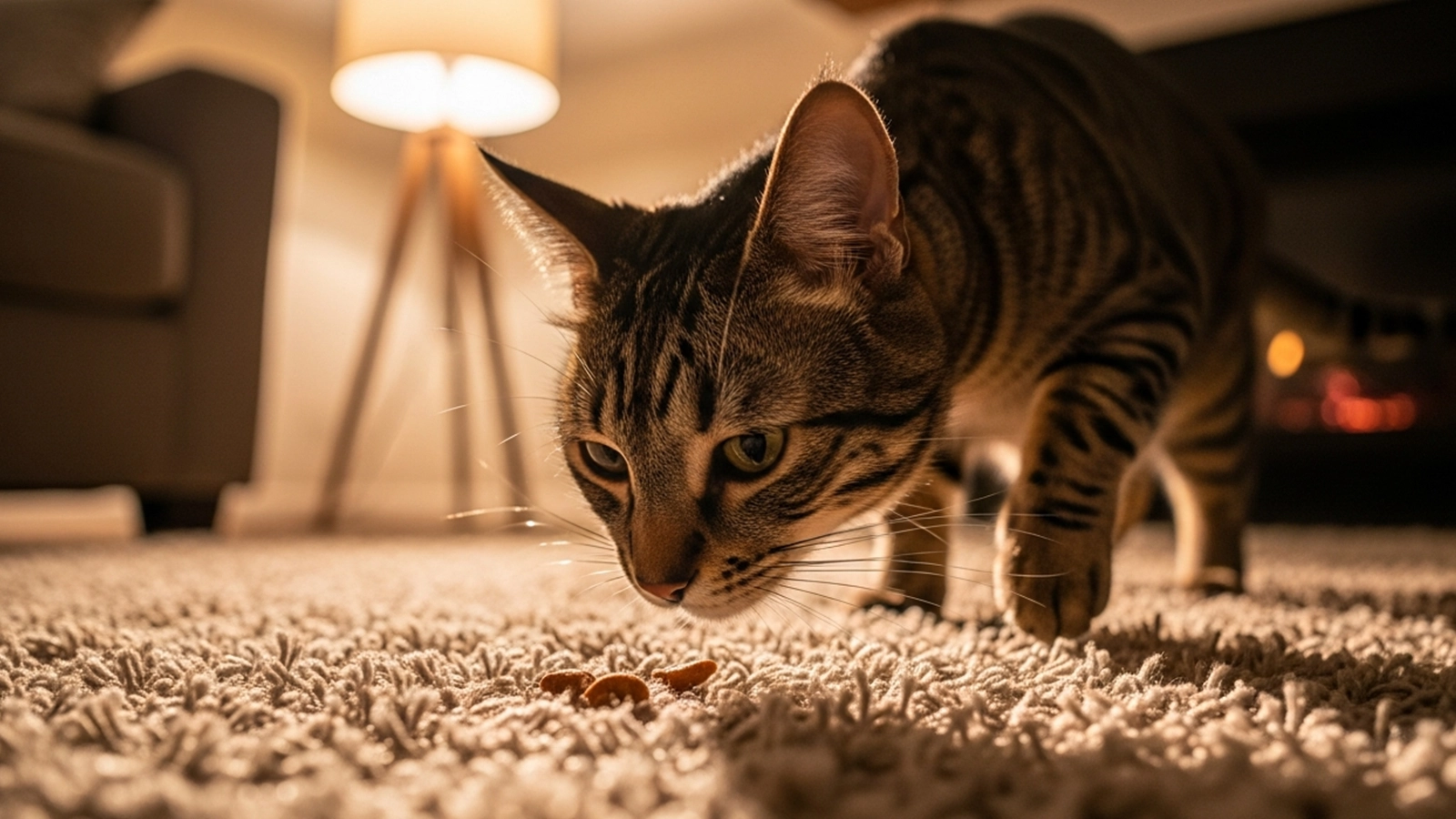
Scent-Based Search Activities
Hide a few treats in predictable locations within one room and allow your cat to locate them using scent.
This type of mental work is deeply satisfying and naturally calming.
Recognizing and Preventing Overstimulation
Some cats reach their stimulation threshold quickly, especially those who are younger, highly sensitive, or previously stressed.
Warning signs include:
-
sharp tail flicking
-
widened pupils
-
sudden grabbing or biting
-
abrupt withdrawal
When these appear, play should stop immediately.
Mental enrichment should leave a cat calmer and more confident—not reactive or overwhelmed.
For sensitive cats, shorter sessions with simpler challenges are far more effective than long, intense play periods.
Independent Evening Enrichment That Encourages Rest
Direct interaction isn’t always necessary in the evening.
Independent activities can gently occupy the mind without increasing arousal.
Low-Effort Puzzle Feeding
Offering part of the evening meal through a simple puzzle encourages slow, thoughtful engagement that naturally leads toward rest.
Passive Observation Zones
A softly lit window perch or elevated resting area allows visual and scent-based engagement without excitement.
Why Timing Matters More Than Play Length
Mental stimulation works best when it’s distributed thoughtfully throughout the day.
When engagement is consistent:
-
frustration decreases
-
emotional regulation improves
-
nighttime behavior softens naturally
A helpful rhythm is:
-
more active problem-solving earlier in the day
-
slower, grounding engagement in the evening
Cats who feel mentally satisfied rarely need to demand stimulation after dark.
When Evening Restlessness Persists
If nighttime activity continues despite regular engagement, it often signals that:
-
the type of stimulation doesn’t match the cat’s preferences
-
instinctual cycles aren’t being completed
-
emotional security needs reinforcement
There is no universal routine. Observation and adjustment matter more than rigid schedules.
As mental needs begin to align with natural rhythms, behavior softens. The cat becomes easier to read, easier to soothe, and easier to support.
That clarity opens the door to something deeper than play alone: understanding how cats communicate comfort, stress, and trust through subtle signals.
How Play Strengthens Communication, Trust, and Emotional Security
By the time mental stimulation is consistent and well-timed, something subtle but powerful begins to shift. Cats don’t just behave differently — they communicate differently.
Play, when done thoughtfully, becomes a shared language.
It’s one of the few moments where cats voluntarily expose their internal state: confidence, hesitation, curiosity, frustration, trust. The way a cat engages in games often reveals more than vocalization ever could.
This is where mental stimulation moves beyond enrichment and becomes emotional infrastructure.
Play as a Window Into Emotional State
Cats rarely communicate discomfort or insecurity directly. Instead, they adjust how they engage.
During play, pay attention to:
-
hesitation before approaching a toy
-
how quickly they disengage
-
whether movement feels fluid or tense
-
how their body settles afterward
A cat that trusts its environment plays with loose muscles, soft focus, and smooth transitions. A cat that doesn’t may appear intense, jumpy, or overly reactive.
These signals are easy to miss unless you know what you’re seeing.
The way cats position their bodies, control their movements, and regulate distance during play often mirrors deeper communication patterns tied to emotional safety and trust, which is why understanding subtle physical cues becomes essential when interpreting how confident or unsettled a cat truly feels during daily interactions, a connection explored through how feline posture and micro-movements quietly communicate emotional state
When play feels off, it’s rarely about the toy — it’s about what the cat is feeling.
Building Trust Through Predictable, Respectful Play
Trust isn’t built through intensity. It’s built through consistency.
Cats feel safest when:
-
play starts and ends predictably
-
their signals are respected immediately
-
they are never forced to engage
Ending a session before a cat becomes overstimulated sends a powerful message: control and safety exist here.
Over time, this creates a feedback loop:
-
the cat feels secure
-
engagement becomes more relaxed
-
communication becomes clearer
Trust grows not because play is exciting, but because it’s emotionally reliable.
Games That Reinforce Confidence and Choice
Confidence-building games allow the cat to decide how and when to engage.
Choice-Based Play Setups
Instead of waving a toy directly at your cat, place it in the environment and let them approach on their own terms.
This supports:
-
autonomy
-
confidence
-
emotional regulation
Low-Pressure Interactive Moments
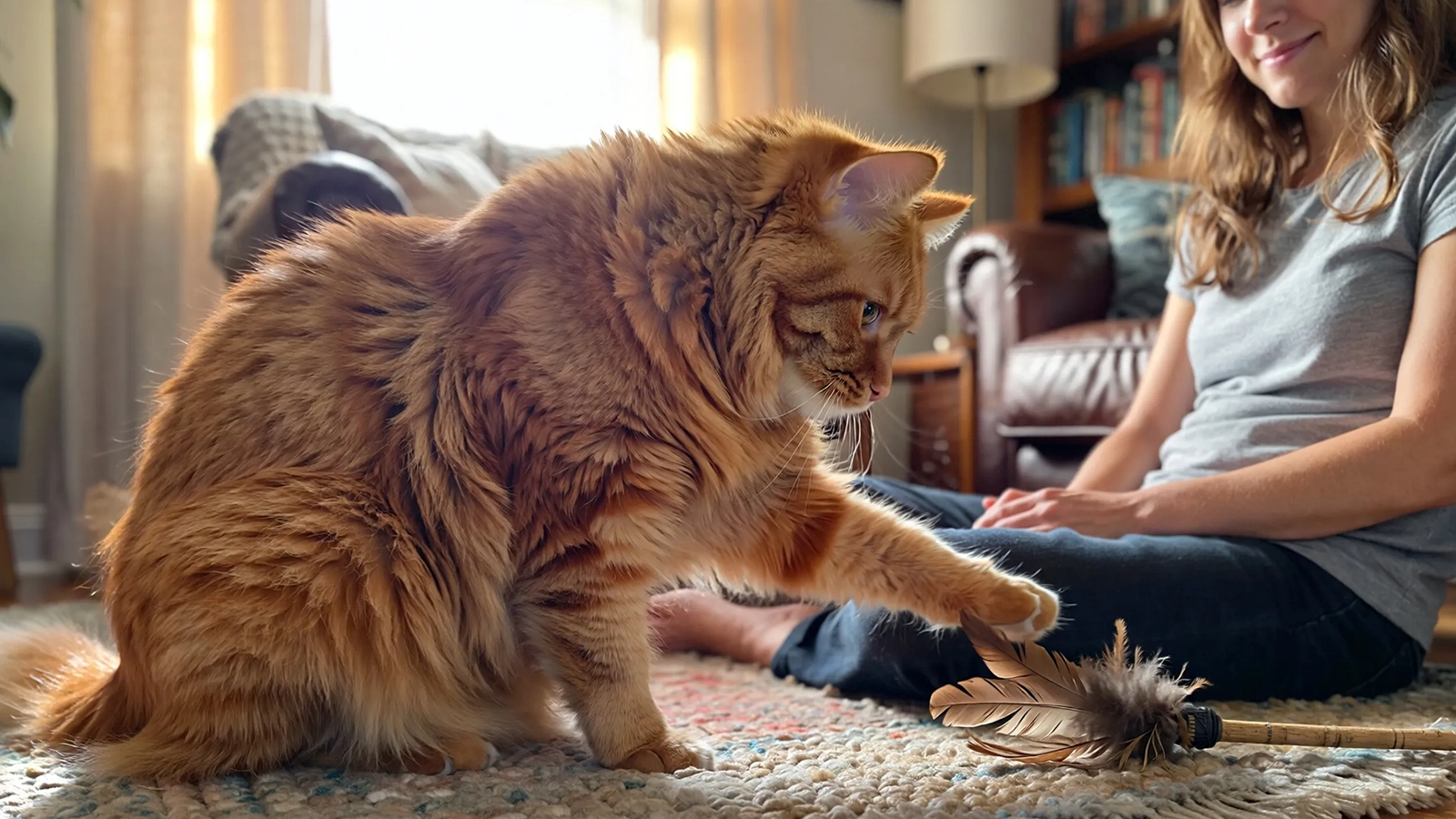
Sit on the floor, move slowly, and keep movements predictable. Let pauses exist.
Silence during play can be just as reassuring as action.
How Mental Games Help Rebuild Trust After Stress
Cats recovering from:
-
environmental changes
-
illness
-
loud events
-
social disruption
often lose confidence temporarily.
Mental games help rebuild trust because they:
-
offer structure
-
restore predictability
-
allow success without pressure
Puzzle feeders, scent games, and slow interactive play give cats a sense of control — something stress often removes.
Rebuilding trust isn’t about doing more. It’s about doing less, more intentionally.
Reading When Not to Play
One of the most overlooked skills in enrichment is knowing when to stop.
Signs your cat needs space include:
-
turning the head away
-
slowing movement
-
tail tightening
-
stepping back rather than forward
Respecting these signals strengthens communication far more than pushing through them.
A cat that feels heard becomes easier to understand.
Mental Stimulation as Emotional Maintenance
When mental engagement is consistent, something remarkable happens.
Cats:
-
vocalize less reactively
-
settle more easily
-
show fewer stress-based behaviors
-
engage with people more softly
This isn’t because they’re “tired.” It’s because their internal needs are being met.
Mental stimulation acts as emotional maintenance — not a fix, but ongoing support.
Bringing It All Together
The best indoor games don’t just entertain. They:
-
complete instinctual cycles
-
support emotional regulation
-
strengthen communication
-
build long-term trust
Play becomes a shared rhythm rather than a burst of activity.
When cats feel mentally satisfied, they don’t need to demand attention through disruption. They communicate calmly, rest deeply, and engage more openly.
That’s when indoor life stops feeling like a limitation — and starts feeling like a secure, enriched world designed with the cat’s inner experience in mind.